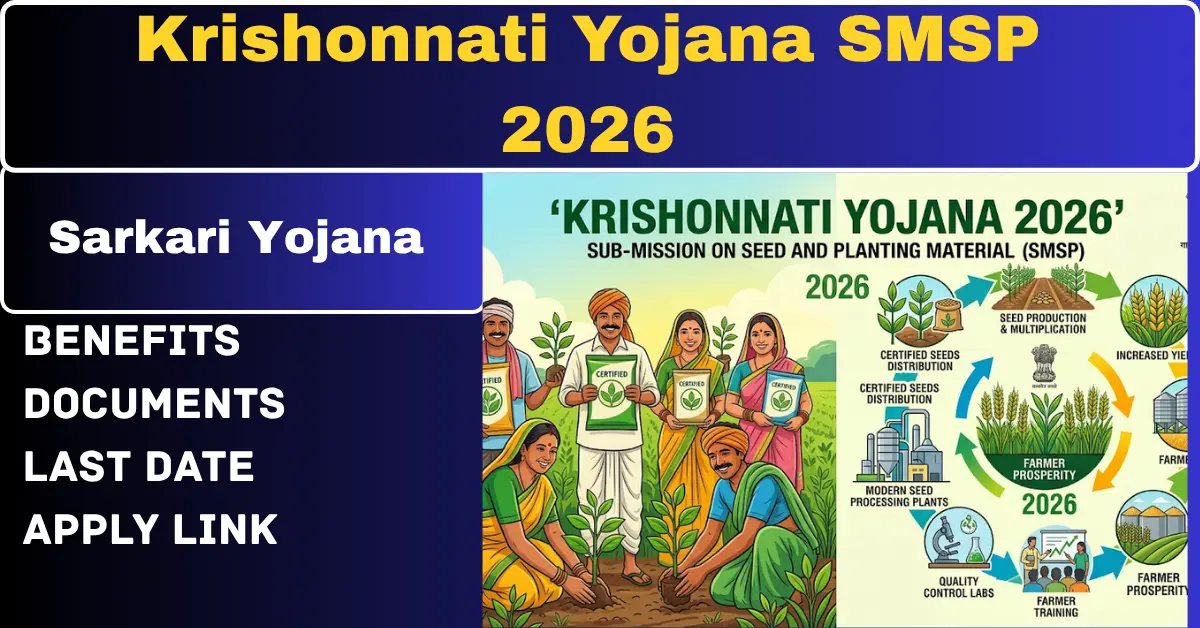
Krishonnati Yojana SMSP 2026 explained simply. Know subsidy, eligibility, benefits, and real farmer advice before applying.
Most farmers I talk to don’t struggle because they don’t work hard — they struggle because they don’t get the right seeds at the right time. And that’s exactly where Krishonnati Yojana – Sub Mission on Seed and Planting Material (SMSP) comes in.
This isn’t some random scheme sitting on paper. If you understand it properly, it can directly impact your crop yield — and yes, your income too.
What Exactly Is Krishonnati Yojana SMSP 2026? (Simple Explanation)
| Details | Information |
|---|---|
| Scheme Name | Sub Mission on Seed and Planting Material (SMSP) |
| Under | Krishonnati Yojana |
| Type | Central Government Scheme |
| Target | Farmers (especially small & marginal) |
| Focus | Quality seeds, subsidy, infrastructure |
Honestly, the name sounds complicated. But the idea is simple — better seeds = better crops = better income.
Here’s the thing — the government isn’t just giving subsidy here. They’re trying to fix the entire seed system — production, storage, testing, everything.
What Benefits You Actually Get (Not Just Theory)
| Benefit Area | What You Get |
|---|---|
| Seed Subsidy | 50%–75% support depending on crop |
| Seed Villages | Training + group farming support |
| Storage Support | Subsidy for storage bins |
| Seed Treatment | Financial help per quintal |
| Infrastructure | Labs, storage, processing units |
Now, let me be straight with you — you won’t get all benefits directly in your bank account.
Most of this support comes through:
- Agriculture department
- Farmer groups
- Seed village programs
So if you’re expecting direct ₹50,000 credit — that’s not how this works.
Who Has the Best Chances to Benefit?
| Criteria | Requirement |
|---|---|
| Farmer Type | Small or Marginal Farmer |
| Documents | Land proof + Aadhaar |
| Bank | Active bank account required |
Honestly, farmers who are part of groups or villages participating in programs get more benefit than individual farmers.
Why? Because schemes like Seed Village Programme focus on groups of 50–150 farmers.
Common Mistake
Most people submit land proof (B1/Khasra) that is:
- outdated
- unclear photocopy
- not matching Aadhaar name
That’s where applications get stuck.
Watch out: Name mismatch between Aadhaar and land record — biggest silent rejection reason.
How You Actually Apply (Offline Reality)
| Step | Action |
|---|---|
| Step 1 | Visit Agriculture Officer |
| Step 2 | Submit application + documents |
| Step 3 | Verification happens |
| Step 4 | Scheme benefit assigned |
Look, there’s no fancy portal here in most states. You’ll have to physically visit:
- District Agriculture Office
- Block Agriculture Office
Now, here’s the thing — timing matters.
If you go after sowing season has already started, you’ll likely miss out.
Pro Tip:
Apply before crop season starts, not after. Most farmers go late — and then complain they didn’t get seeds.
Documents You’ll Need (And Where People Mess Up)
| Document | Purpose | Common Mistake |
|---|---|---|
| Aadhaar Card | Identity | Mobile not linked |
| Land Record (B1/Khasra) | Ownership proof | Old copy used |
| Bank Passbook | Payment tracking | Inactive account |
Honestly, getting documents isn’t hard — keeping them correct is.
If you don’t have updated land record:
- Visit local revenue office
- Or check online state portal
Where Most Farmers Lose Out (Real Talk)
Honestly, not because the scheme is bad.
They lose because:
- They don’t know timing
- They apply individually instead of group
- They don’t follow up
Here’s the thing — officers won’t call you repeatedly. You have to follow up.
If I were in your place, I’d visit the office at least 2–3 times during process.
How Much Money or Support You Really Get?
Let’s clear one confusion of Krishonnati Yojana SMSP 2026
You won’t get a fixed amount like ₹10,000 or ₹20,000.
Instead, benefits are like:
- 50% subsidy on seeds
- 75% subsidy on treatment
- Storage support
- Training programs
Now, compare this with market reality — seeds are expensive. Even saving ₹2,000–₹5,000 per season matters.
And over 2–3 seasons? That’s serious savings.
My Honest Opinion (Not in Official Info)
Here’s the thing — this scheme works best if:
- You’re already farming actively
- You’re open to learning new seed methods
- You’re willing to work in groups
If you’re expecting quick cash benefit — you’ll feel disappointed.
But if you want to improve yield long-term — this is actually useful.
Most guides won’t tell you this — seed quality impacts income more than fertilizer in many cases.
One Question Farmers Always Ask
“Will this increase my crop income?”
Short answer — yes, but indirectly.
Better seeds – better germination – better yield – more income.
But only if:
- You follow proper farming practices
- You don’t ignore training sessions
How Seed Village Programme Actually Works (This Is Where Real Benefit Is)
Now, this part is important — and honestly, most farmers skip understanding it.
The Seed Village Programme sounds like a government term, but in simple words, it means:
farmers in one area work together to produce and use better quality seeds.
| Feature | What Happens |
|---|---|
| Group Size | 50–150 farmers |
| Support | Training + seed subsidy |
| Output | Certified or improved seeds |
Here’s the thing — instead of buying seeds every season, farmers learn to produce quality seeds themselves.
That changes everything.
So, instead of depending on the market (where prices fluctuate), you build your own seed system.
Honestly, if your village has this program and you ignore it — you’re missing one of the strongest parts of the scheme.
Pro Tip:
If your village isn’t part of a seed village yet, ask your Agriculture Officer directly. Sometimes they select villages based on demand.
Timing Matters More Than You Think
Look, agriculture schemes are not like exams where there’s one fixed deadline.
Here, everything depends on crop season.
| Season | When You Should Apply |
|---|---|
| Kharif | March – May |
| Rabi | September – November |
Now, here’s the mistake most people make.
They go to the office after sowing starts. By then:
- Seeds are already distributed
- Lists are already finalized
And then they say “scheme ka benefit nahi mila.”
Honestly, it’s not rejection — it’s late timing.
Watch out:
Even if you’re eligible, late application = no benefit for that season.
What Training Actually Teaches You (Don’t Skip This)
So, many farmers think training is time waste.
Let me be straight — that mindset is costing money.
Training under this scheme usually covers:
- Seed treatment methods
- Storage techniques
- New crop varieties
Now, think practically.
If your seeds get fungus or lose quality in storage, your yield drops. Simple.
Training solves that.
Honestly, farmers who attend training regularly see better results — not immediately, but over 1–2 seasons.
Seed Storage — The Most Ignored Advantage
Here’s something most guides won’t tell you.
You might be losing money not in farming… but in storage.
Under SMSP, you get support for:
- Seed storage bins
- Godowns
- Processing units
| Type | Benefit |
|---|---|
| Storage bins | Prevent moisture damage |
| Godowns | Bulk storage |
| Processing units | Clean and grade seeds |
Now, imagine this.
You store seeds properly → no damage → better germination → higher yield.
Small change. Big impact.
What Happens After You Get the Benefit?
Now, this is a real question nobody answers.
After you receive subsidy or support:
- You’re expected to use it properly
- Officers may inspect usage
- In group schemes, performance matters
Here’s the thing — if you misuse or don’t follow guidelines, next time your application might not be prioritized.
So don’t treat it like a one-time benefit. Treat it like a long-term system.
Common Ground Reality Problems (And How to Handle Them)
Honestly, let’s talk real life — not just scheme theory.
Problem 1: “Officer is not responding”
Solution: Visit during working hours, not lunch time or closing time. Sounds basic, but it matters.
Problem 2: “No information in village”
Solution: Go to block office directly. Don’t depend only on word of mouth.
Problem 3: “Application stuck”
Solution: Check documents first. 70% issues are document-related, not approval-related.
If I Were Applying — My Strategy
Let me tell you how I’d approach this, step by step:
- First, confirm with Agriculture Officer about current schemes
- Second, try joining or forming a farmer group
- Third, apply before season starts
- Fourth, attend training seriously
- Fifth, follow up regularly
No shortcuts here — but results are real.
Final Thought Before You Decide
So, what’s the bottom line?
This scheme won’t change your life overnight. But it can quietly improve your farming year after year.
And honestly — that’s how real progress happens in agriculture.
Small improvements. Consistent results. Better income over time.Final Recommendation — Should You Go for It?
So, let me give you straight advice.
If you are:
- Small farmer
- Struggling with low yield
- Ready to work with agriculture officers
Then yes, go for it.
But if you:
- Want quick subsidy cash
- Don’t want to visit offices
- Prefer working alone
Then honestly, this may not suit you.
FAQ – Real Questions Farmers Ask
1. Can I apply individually or do I need a group?
You can apply individually, but group-based benefits like seed villages give better support. Honestly, group farmers get more advantage.
2. Is there any direct money transfer?
No fixed direct transfer like DBT in most cases. Benefits come as subsidy, support, or training.
3. What crops are covered under this scheme?
Mostly major crops like paddy, pulses, oilseeds, cotton, etc. It depends on your state implementation.
4. How long does approval take?
Usually a few weeks to a couple of months. It depends on local office workload — follow-up matters.
5. Can tenant farmers apply?
The notification doesn’t clearly say, but from experience — land ownership proof is usually required. Tenant farmers face difficulty.
Important Links
| Resource | Link |
|---|---|
| Official Agriculture Portal | Check your State Website |
| Application Mode | Visit Local Agriculture Office |
| Scheme Details | Available at District Office |