NDA Syllabus 2026 with subject-wise topics explained in simple language, strategy, and real preparation advice for beginners.
If you’re thinking about NDA, one thing is clear — this is not just another exam. It’s a filter. And the syllabus? That’s your first battlefield.
Most students make one mistake right here. They read the syllabus once… and then forget it exists. Honestly, that’s why they keep studying randomly and don’t see results.
So let’s fix that. I’ll break this down the way I explain it to my juniors — simple, practical, and with a bit of reality check where needed.
NDA Syllabus 2026 with subject-wise topics — understand this before opening any book
Before syllabus, you need clarity on how marks are actually distributed. Because that decides your strategy.
| Subject | Questions | Marks | Time | Negative Marking |
|---|---|---|---|---|
| Mathematics | 120 | 300 | 2.5 hours | -0.83 |
| General Ability Test (GAT) | 150 | 600 | 2.5 hours | -1.33 |
| Total (Written) | — | 900 | — | — |
| SSB Interview | — | 900 | — | — |
Now look carefully — GAT has double weightage of Maths.
Here’s the thing — most students do the opposite. They spend 70% time on Maths because it’s “tough”, and ignore GAT. Big mistake.
Reality: Many candidates fail because they don’t clear cutoff in both papers. Maths strong but GAT weak? Out. GAT strong but Maths weak? Still out.
Pro Tip:
If you’re average in Maths, don’t try to become a topper there. Aim for safe marks (120–150). Then push GAT hard — that’s where rank improves.
NDA Syllabus 2026 — big picture first
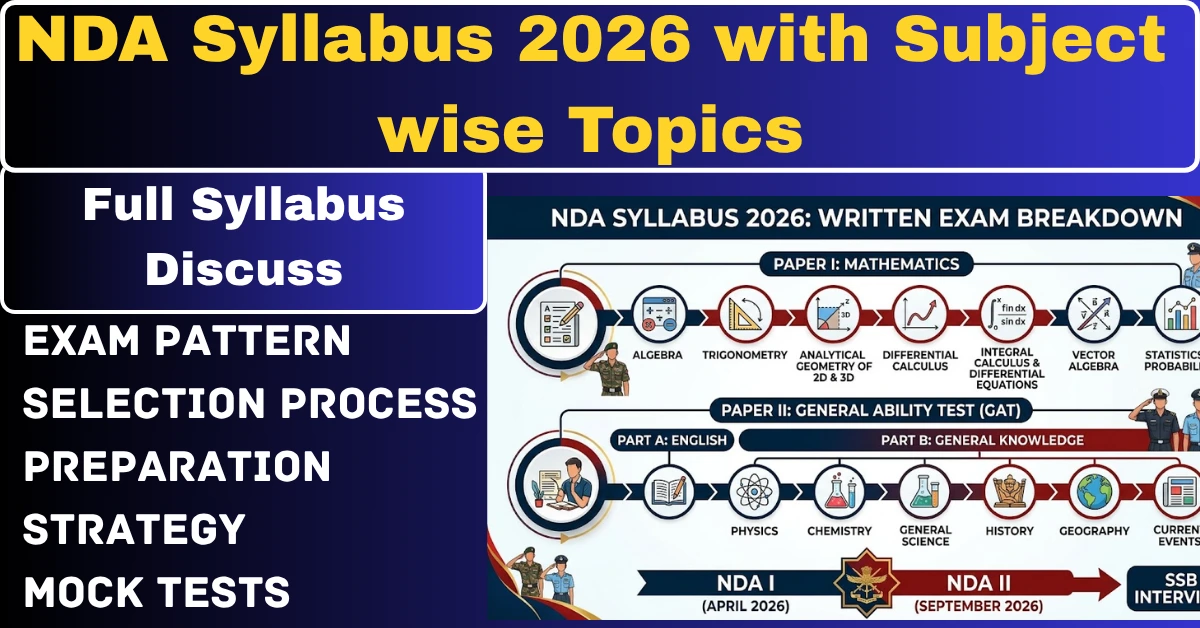
The syllabus is divided into just two parts:
| Paper | What it Covers | Marks |
|---|---|---|
| Mathematics | Class 11–12 Maths | 300 |
| GAT | English + GK (Physics, Chemistry, History, etc.) | 600 |
So yes — NCERT is your base. No shortcut here.
But wait — that doesn’t mean you need to study everything equally. Let me show you how to think about it smartly.
Mathematics Syllabus — where most students struggle (and why)
Honestly, Maths is not “hard”. It’s unforgiving. One small mistake and marks gone.
Main Topics You Need to Cover
| Topic | Key Areas |
|---|---|
| Algebra | Sets, Relations, Quadratic Equations, Logarithms |
| Trigonometry | Identities, Heights & Distance |
| Calculus | Limits, Derivatives, Integration |
| Matrices & Determinants | Inverse, Cramer’s Rule |
| Geometry (2D & 3D) | Lines, Circles, Conics |
| Statistics & Probability | Mean, Probability basics |
Now let me be straight with you — not all topics are equal.
What actually matters more?
- Calculus + Algebra = high weightage
- Trigonometry = scoring but formula-heavy
- 3D Geometry = fewer questions, don’t over-invest time
Most guides won’t tell you this, but NDA Maths is less about deep theory and more about speed + accuracy.
Where students fail in Maths
- They understand concepts but don’t practice enough
- They don’t revise formulas daily — big mistake
- They ignore previous year questions
If I were you:
I’d solve at least 20–25 questions daily and revise formulas every night — even if for 15 minutes.
GAT Syllabus — the real game changer
So, this paper decides your rank. And surprisingly, it’s also the most ignored.
Structure of GAT
| Section | Marks |
|---|---|
| English | 200 |
| General Knowledge | 400 |
English Section — easiest marks, but only if you prepare smartly
| Topics |
|---|
| Grammar |
| Vocabulary |
| Synonyms/Antonyms |
| Idioms & Phrases |
| Sentence Improvement |
| Comprehension |
Look, this is not UPSC-level English. It’s basic — but tricky.
Here’s what happens: students think “English toh aata hai” and skip preparation. Then exam day — confusion.
My advice:
Solve previous papers. Patterns repeat a lot here.
General Knowledge — vast but manageable (if you divide properly)
Now, this is where things feel overwhelming. Physics, Chemistry, History, Geography… everything.
Let’s simplify.
Physics (focus on basics, not numericals)
| Important Areas |
|---|
| Motion, Laws of Motion |
| Work, Energy |
| Heat, Sound |
| Light (Reflection/Refraction) |
| Electricity |
Honestly, questions are mostly concept-based, not calculation-heavy.
Chemistry — memory + understanding combo
| Important Areas |
|---|
| Acids, Bases, Salts |
| Elements & Compounds |
| Chemical Reactions |
| Atomic Structure |
Watch out:
Students ignore Chemistry thinking it’s small. But easy marks yahi milte hain.
General Science (Biology basics)
| Important Areas |
|---|
| Human Body |
| Nutrition |
| Diseases |
| Cells |
No need for deep biology. Just NCERT-level clarity.
History & Geography — where many lose marks unnecessarily
| Subject | Focus |
|---|---|
| History | Freedom Movement, Revolutions |
| Geography | Climate, Earth, Resources |
Here’s the thing — mugging won’t work. You need story understanding.
Current Affairs — daily habit, not last-minute
| Coverage |
|---|
| National events |
| International news |
| Sports & personalities |
Even 10 minutes daily is enough. But skip it for a month? Then backlog becomes scary.
SSB Interview — syllabus doesn’t show this, but this decides selection
Now listen carefully — clearing written exam is just half the journey.
SSB = 900 marks.
Honestly, many toppers fail here. Why? Because this is not about knowledge.
They check:
- Personality
- Confidence
- Decision-making
- Communication
The notification doesn’t explain this deeply, but from past experience — fake personality gets caught quickly.
If you’re preparing seriously:
Start speaking clearly, stay updated, and build confidence early.
How much time do you really need for NDA 2026?
Officially, people say 6–8 months.
But let me be honest — it depends on your current level.
- Strong basics? 4–6 months enough
- Average student? 6–8 months
- Weak Maths? Give 8–10 months
Pro Tip:
Don’t wait for “perfect plan”. Start with NCERT today. That’s already progress.
Preparation Strategy — what actually works (not theory)
So, how should you study?
1. Start with NCERT (non-negotiable)
Class 11–12 Maths + Science. Build base first.
2. Mock tests — don’t delay this
Most students take mocks only at the end. Wrong move.
Start after 2–3 months of prep.
3. Revision system (this is where toppers win)
Now, this is underrated.
- Weekly revision
- Formula notebook
- Mistake notebook
Without revision, you’re just forgetting things slowly.
4. Balance both papers
Here’s the thing — NDA is not about being best in one subject.
It’s about clearing both + scoring decent overall.
One thing nobody tells you about NDA preparation
Honestly, NDA preparation can feel lonely — especially if you’re from a small town without guidance.
You’ll doubt yourself. You’ll compare with others. Totally normal.
But here’s what matters — consistency beats talent here.
Even average students crack NDA every year. Because they stayed regular.
Your Biggest Hidden Enemy — not syllabus, but inconsistency
Honestly, NDA syllabus is not impossible. It’s actually quite limited compared to exams like UPSC CSE.
But here’s the real problem — students don’t study consistently.
One day 6 hours. Next day zero. Then guilt. Then restart. This cycle kills preparation.
Look, NDA is more like a fitness routine than an academic exam. You don’t build strength in one day — same here.
Even 3–4 hours daily, done seriously, beats random 8-hour bursts.
How to stay consistent (simple, practical system)
Now, I’ll tell you something I’ve seen work again and again.
- Fix a daily time slot — same time, every day
- Keep one subject light (like English or Current Affairs)
- Track what you actually studied — not what you planned
Pro Tip:
Don’t make big timetables. Make a next-day plan only. That’s easier to follow.
Genuine Recommendation — should YOU prepare for NDA 2026?
Look, I’ll be very clear.
Go for NDA if:
- You genuinely want defence life (not just “uniform attraction”)
- You’re okay with discipline and tough routine
- You can stay consistent for months
Think twice if:
- You hate Maths completely
- You’re only applying because “someone told you”
If I were in your place, I’d give NDA a serious attempt once — properly prepared. Not half-hearted.
FAQs — real questions students ask
1. Can I crack NDA without coaching?
Yes, you can. Many students do it every year. But you need discipline — daily study + mock tests + self-analysis. Without that, coaching also won’t help.
2. Is NDA Maths tougher than board exams?
Level is similar to Class 11–12, but questions are trickier and time-bound. Speed matters more than depth.
3. How many hours should I study daily?
If you’re serious — 5 to 7 hours daily is enough. But consistency matters more than long study hours.
4. What happens if I clear written but fail SSB?
You’ll have to start again from written exam next cycle. That’s why don’t ignore personality development.
5. Is current affairs really important for NDA?
Yes, especially for GAT and SSB. But you don’t need deep analysis — just regular awareness.
Important Links
| Resource | Link |
|---|---|
| Official UPSC Website | https://upsc.gov.in |
| NDA Notification (when released) | UPSC Exams Section |
| Previous Year Papers | Available on UPSC site |
| NCERT Books | https://ncert.nic.in |