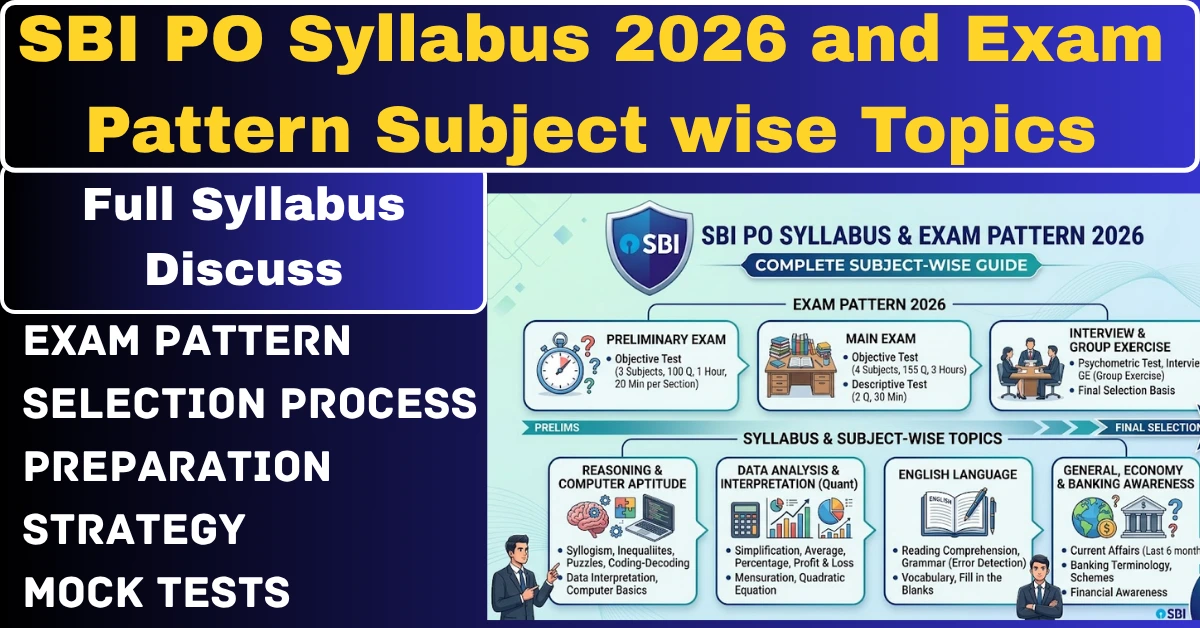
SBI PO Syllabus 2026 and exam pattern subject wise topics, and real preparation strategy explained in simple language for beginners.
Thinking about SBI PO, you’re not just preparing for an exam — you’re competing with lakhs of serious candidates. And honestly, most people don’t fail because the syllabus is tough… they fail because they don’t understand how the exam really works.
So instead of dumping topics on you, I’ll explain what you should actually focus on — like I would if you called me and asked, “Bhaiya, how do I crack SBI PO?”
SBI PO Syllabus 2026 and exam pattern subject wise topics– Understand the Game First
| Particular | Details |
|---|---|
| Exam Conducting Body | State Bank of India |
| Post | Probationary Officer (PO) |
| Selection Stages | Prelims, Mains, Psychometric Test, Interview |
| Mode | Online |
| Total Marks | Prelims 100, Mains 250 |
| Negative Marking | 0.25 marks per wrong answer |
| Language | English + Hindi (except English section) |
Honestly, SBI PO isn’t about who studies more. It’s about who studies smart and handles pressure.
SBI PO Exam Pattern 2026 – Where Most People Get Shocked
Prelims Pattern
| Section | Questions | Marks | Time |
|---|---|---|---|
| English Language | 40 | 40 | 20 min |
| Quantitative Aptitude | 30 | 30 | 20 min |
| Reasoning Ability | 30 | 30 | 20 min |
| Total | 100 | 100 | 60 min |
So, here’s the thing — you get only 20 minutes per section. That’s where people panic.
Honestly, speed matters more than knowledge here. You might know everything, but if you can’t attempt quickly, you’re out.
Watch out: Last 2–3 minutes panic ruins accuracy. Practice full mocks, not just questions.
Mains Pattern
| Section | Questions | Marks | Duration |
|---|---|---|---|
| Reasoning & Computer | 40 | 60 | 50 min |
| Data Analysis | 30 | 60 | 45 min |
| GA/Banking | 60 | 60 | 45 min |
| English | 40 | 20 | 40 min |
| Objective Total | 170 | 200 | 3 hrs |
| Descriptive | 3 | 50 | 30 min |
Now, this is where real selection happens.
Prelims just filters. Mains decides your future.
What You Actually Need to Study – Subject Wise Breakdown
Reasoning – Your Make or Break Section
Look, puzzles will decide your rank. Not basic questions.
Topics include:
- Seating arrangement
- Puzzle (floor, box, scheduling)
- Coding-decoding
- Syllogism
- Blood relations
Honestly, beginners struggle here because they jump directly to hard puzzles.
If I were you, I’d start with easy sets, then gradually increase difficulty. Daily practice is non-negotiable.
Quantitative Aptitude – Accuracy Game
Topics include:
- Data Interpretation
- Profit and Loss
- Time and Work
- Percentage
- Ratio and Proportion
Here’s the thing — calculation speed is everything.
Most students know formulas but waste time in calculations. That’s the real problem.
Pro Tip: Learn shortcut tricks, but don’t depend only on tricks. Basics strong honi chahiye.
English Language – Ignore Mat Karo
Topics include:
- Reading comprehension
- Cloze test
- Error spotting
- Vocabulary
Honestly, many Hindi-medium students ignore English. Big mistake.
Even in Mains descriptive, English decides your selection.
So daily reading — even 15 minutes — makes a huge difference.
General Awareness – The Silent Rank Booster
Topics include:
- Banking awareness
- Current affairs
- Financial news
Now, most guides won’t tell you this — GA is the easiest section to score high.
No calculation. No logic. Just memory.
But consistency chahiye. One month current affairs isn’t enough.
Selection Process – Where Candidates Actually Fail
| Stage | Reality Check |
|---|---|
| Prelims | Cutoff clear karna is tough due to competition |
| Mains | Most students fail here |
| Interview | Average students also get rejected |
Honestly, interview mein knowledge se zyada personality dekhi jaati hai.
Confidence. Clarity. Communication.
That’s what matters.
Marking Scheme – Small Mistake, Big Loss
| Type | Marks |
|---|---|
| Correct Answer | Full marks |
| Wrong Answer | -0.25 |
| Unattempted | No penalty |
Here’s the thing — random guessing will destroy your score.
Better to leave doubtful questions.
Descriptive Paper – The Most Ignored Section
Now, this is interesting.
You’ll have:
- Email writing
- Essay
- Situation-based writing
Most students ignore this completely.
Then exam day pe panic.
Honestly, if you practice even 5–6 essays before exam, you’ll be ahead of 80% candidates.
Application & Strategy – What You Should Do Practically
Look, don’t make this mistake — filling form and then “dekhenge baad mein”.
Here’s what I suggest:
- Use laptop for form filling (mobile errors common hote hain)
- Double-check name, DOB — mismatch = rejection
- Keep documents ready in correct size
After applying:
Start mock tests within 10–15 days. Don’t wait to “complete syllabus”.
Pro Tip: Apply early — last day server issue is real. Many students miss submission.
Documents You’ll Need (And Common Mistakes)
| Document | Watch Out |
|---|---|
| Aadhaar Card | Name mismatch |
| Graduation Certificate | Final year confusion |
| Photo & Signature | Wrong size upload |
| Category Certificate | Old format rejected |
| Bank Details | Incorrect IFSC |
Honestly, biggest mistake? Uploading blurred documents.
What Most Students Do Wrong (And How You Can Avoid It)
Honestly, this is the part no one talks about clearly. Everyone gives you syllabus, books, strategy… but very few tell you where candidates actually mess up.
First mistake — studying everything but mastering nothing. You’ll see students solving 10 different topics daily but still not confident in any. SBI PO doesn’t reward “thoda thoda sab”. It rewards depth. If puzzles are your weak area, spend 2 hours there instead of running behind 5 subjects.
Second mistake — avoiding mock tests because score low aa raha hai. Look, low score is feedback, not failure. If you keep delaying mocks, you’ll face real exam pressure directly — and that’s risky.
Third one is overconfidence in Prelims. Many candidates clear mocks easily and think “ho jayega”. Then actual exam surprises them with tougher questions and time pressure.
If I were in your place, I’d treat every mock like the final exam. Same seriousness. Same environment.
How to Plan Your 60–90 Day Preparation (Realistic Plan)
Now, let me give you a practical roadmap. Not theory. Something you can actually follow.
First 30 Days – Build Base
So, focus on basics:
- Arithmetic (Quant)
- Basic reasoning (coding, syllogism)
- Daily English reading
Honestly, don’t touch advanced puzzles yet if basics are weak. That’s where most people go wrong.
Daily 2–3 hours is enough if consistent.
Next 30 Days – Increase Level
Now things get serious.
Start:
- Full-length puzzles
- Data Interpretation sets
- Sectional mocks
Look, your brain needs training for speed. Just learning concepts won’t help anymore.
This phase decides whether you’ll clear Prelims or not.
Last 30 Days – Mock + Analysis
Here’s the thing — mocks alone won’t help. Analysis is everything.
Spend:
- 1 hour mock
- 2 hours analysis
Check:
- Where you wasted time
- Which questions you guessed wrong
- Which topics are still weak
Watch out: Don’t give 3 mocks daily without analysis. That’s time waste.
How to Handle Exam Day Pressure
Honestly, even well-prepared students panic on exam day.
So what should you do?
First, don’t try new strategy in exam hall. Jo practice kiya hai wahi follow karo.
Second, if one section goes bad — forget it. Next section is fresh chance.
Third, don’t chase attempts. Quality matters more.
I’ve seen candidates attempt 85 questions and fail… and others attempt 70 and clear comfortably.
Prelims vs Mains Mindset – Biggest Difference
Look, this is important.
Prelims mindset:
Speed. Accuracy. Time management.
Mains mindset:
Depth. Concept clarity. Smart selection of questions.
Most students use same approach for both — and that’s why they get stuck.
One Question You Should Ask Yourself
Now, I’ll ask you something directly.
Are you preparing seriously… or just hoping things will work out?
Because SBI PO doesn’t work on hope.
It works on:
- Daily consistency
- Smart practice
- Honest self-analysis
Even average students crack it — but only when they stay disciplined.
My Honest Opinion – Should You Prepare for SBI PO?
Honestly, this exam is not for casual preparation.
If you’re serious — ready to study 5–6 hours daily for 4–5 months — then go for it.
If you’re preparing along with job without discipline… it gets very difficult.
Now, if you ask me personally:
If you want stability + good salary + respect — SBI PO is worth it.
But if you want quick selection with less competition, you might explore other exams too.
FAQ – Real Questions Students Ask
1. How much time is enough for SBI PO preparation?
Honestly, 3–4 months is enough if you study seriously daily. Casual study won’t work here.
2. Is SBI PO tougher than SSC exams?
Yes. Competition and difficulty level — both are higher compared to most SSC exams.
3. Can beginners crack SBI PO in first attempt?
Yes, but only if your basics are clear and you practice mocks regularly.
4. Is coaching necessary for SBI PO?
Not really. Online resources + mock tests are enough if you’re disciplined.
5. What is the most scoring section?
General Awareness in Mains and Reasoning in Prelims — if prepared well.
Important Links
| Purpose | Link |
|---|---|
| Official Website | https://sbi.co.in |
| Syllabus PDF | Available on official site |
| Apply Online | Through SBI Careers page |