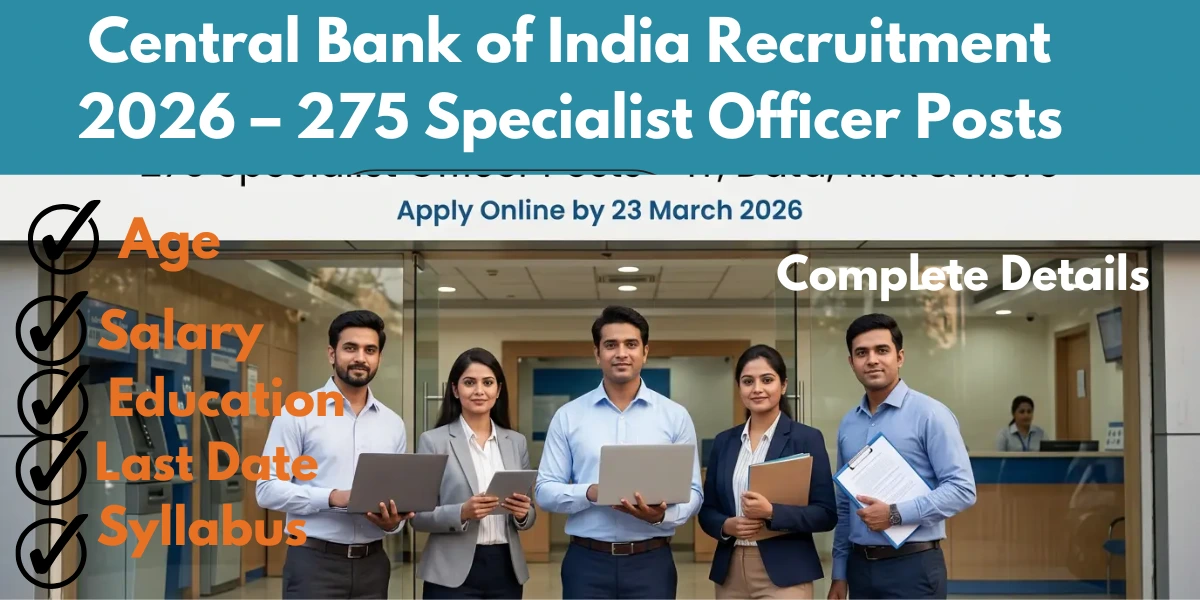
Central Bank of India Recruitment 2026 : Look, if you’re from a tech or finance background and tired of private job uncertainty, this notification will definitely catch your eye. Government bank + specialist role – sounds stable, right?
But here’s the thing – this isn’t a fresher-friendly recruitment. This is for people who already have some real experience. So before you get excited and rush to apply, let’s break it down properly – like I’d explain to my younger brother.
Recruitment Overview (Quick Snapshot)
| Detail | Information |
|---|---|
| Organization | Central Bank of India |
| Total Posts | 275 |
| Post Name | Specialist Officer (SO) |
| Application Mode | Online |
| Job Location | Across India |
| Last Date | 23 March 2026 |
| Exam Date | April 2026 |
| Interview | April 2026 |
Honestly, the biggest takeaway here – timeline is tight. You don’t have months to prepare.
Post-Wise Vacancy Breakdown (Where You Fit In)
Here’s where it gets interesting – especially for IT folks.
| Post | Vacancies |
|---|---|
| Java Developer | 13 |
| Mobile Developer | 3 |
| .NET Developer | 6 |
| Database Admin | 11 |
| Digital Channel Roles | 23 |
| Linux / SRE / OpenShift | 14 |
| Cyber Security | 38 |
| Network Security | 5 |
| Production Support | 26 |
| Data Engineer / ETL | 15 |
| Data Scientist | 6 |
| Gen AI | 2 |
| IT Officer | 82 |
| Risk Manager | 4 |
| CA | 2 |
Now, let me be straight with you – IT Officer (82 posts) is your safest bet if you’re from a general IT background. Highly specialized roles like Gen AI or Data Architect? Competition will be intense and profiles very specific.
What Qualification Do You Actually Need?
For IT Roles (Most Posts)
| Requirement | Details |
|---|---|
| Degree | B.E./B.Tech / MCA |
| Branch | CS / IT / Electronics or related |
| Experience | 2 to 10 years (depends on scale) |
Here’s the thing – degree alone won’t help. They will look at real project experience.
Honestly, if your resume has only support work and no development exposure, you might struggle in the interview round.
For Risk Manager
| Requirement | Details |
|---|---|
| Degree | MBA / MMS / PG in Finance/Statistics |
| Experience | Minimum 3 years |
For CA Role
| Requirement | Details |
|---|---|
| Qualification | Chartered Accountant |
| Experience | Minimum 2 years |
Common mistake:
People upload wrong experience certificates – either missing joining date or role details. That’s enough to reject you later.
Age Limit – What It Means Practically
| Scale | Max Age |
|---|---|
| Scale I | 30 Years |
| Scale II | 35 Years |
| Scale III | 35 Years |
| Scale IV | 45 Years |
Relaxation:
- SC/ST: 5 years
- OBC: 3 years
Now, here’s where many candidates mess up.
“Age relaxation” doesn’t mean automatic eligibility. It applies only if you have valid category certificate in correct format.
Watch out: If your OBC certificate is older than 1 year or not in central format – rejection is very common.
Important Dates – What You Should Do
| Event | Date |
|---|---|
| Last Date to Apply | 23 March 2026 |
| Exam | April 2026 |
| Interview | April 2026 |
Honestly, don’t wait till last week.
Servers crash. Payment fails. OTP delays happen – every single time.
👉 Apply within first 5 days. No drama.
Application Fee
| Category | Fee |
|---|---|
| General / OBC / EWS | ₹850 |
| SC / ST / PWD / Female | ₹175 |
Simple advice – pay via UPI or debit card. Net banking sometimes fails during peak time.
Selection Process – Where Most People Lose
| Stage | Details |
|---|---|
| Online Exam | Technical + aptitude |
| Interview | Final selection |
Here’s the thing – interview is the real filter.
Many candidates clear written exam, but fail in interview because:
- They can’t explain their own projects
- They don’t understand basics (API, DB, system design)
- Resume is exaggerated
Honestly, if you’re applying for Java role and can’t explain REST API or multithreading – it’s over.
Realistic prep time: 20-30 days minimum if you’re already working.
Salary – Let’s Talk Honestly
Notification says “as per scale”.
But what does that mean?
- Scale I: ~₹36k-₹63k basic
- Scale II/III: Higher depending on level
- With allowances -> ₹70k-₹1.2L (approx)
Now, here’s my honest take –
Private companies may offer higher CTC, but here you get:
- Job stability
- Fixed working hours (mostly)
- Less sudden layoffs
So it depends on your priority.
Job Location – Reality Check
| Location | Details |
|---|---|
| Posting | Anywhere in India |
So, if you’re thinking “Mumbai ya Pune hi milega” – don’t assume that.
You could get posted in any zone depending on requirement.
How to Apply (Without Making Silly Mistakes)
Device Advice
- Use laptop only
- Avoid mobile – formatting issues happen
While Filling Form
- Name must match Aadhaar exactly
- Upload clear documents (PDF/JPEG only)
- Keep file size under limit
Common errors:
- Blurry photo
- Wrong signature
- Incomplete experience details
After Submission – What Next?
Most people relax after applying. Big mistake.
- Start preparation immediately
- Keep documents ready for verification
- Track admit card regularly
Documents You’ll Need (And Where People Go Wrong)
| Document | Tip |
|---|---|
| Aadhaar Card | Name must match form |
| Degree Certificate | Final, not provisional |
| Experience Letter | Must mention role & duration |
| Caste Certificate | Central format only |
| Photo/Signature | Clear and recent |
Watch out: Experience proof without salary slips sometimes gets questioned.
One Thing Most Blogs Won’t Tell You
Here’s the thing – this recruitment is not mass hiring like IBPS PO.
This is lateral hiring.
That means:
- Your resume matters a LOT
- Your domain knowledge matters more than aptitude
- Interview panel will test practical understanding
If I were applying – I’d spend more time revising my real projects than solving random aptitude questions.
Should You Apply or Not? (Honest Advice)
Honestly, apply if:
- You have 2+ years real IT/Finance experience
- You want stability over high salary
- You’re okay with relocation
Maybe skip or rethink if:
- You’re a fresher
- Your experience is not relevant
- You’re expecting private-level salary growth
No hype – just reality.
FAQs (What People Actually Ask)
1. Can freshers apply for Central Bank SO 2026?
No. Almost all roles require relevant work experience. Freshers won’t qualify for most Specialist Officer posts.
Honestly, this is where many candidates waste time — they apply hoping “maybe consider kar lenge.” But banks are strict here. These roles are meant for professionals who already have hands-on experience in IT, Risk, Finance, etc.
2. Is this exam very tough?
Not extremely tough in terms of syllabus. Questions are usually moderate level.
But here’s the real challenge — competition. You’re not competing with fresh graduates, but with experienced professionals who already work in similar roles. That changes the game completely.
3. What happens after selection?
After selection, you’ll join as a Specialist Officer (SO) and work in your domain — like IT, Risk, Finance, Law, etc.
Work is role-specific, not general banking. That means:
- More responsibility
- More technical tasks
- Less routine clerical work
4. Can I choose my posting location?
No. Posting is based on bank requirements, not your preference.
You might get metro city, or you might get a less preferred location. If you’re applying, you should be mentally ready for relocation.
5. Is interview more important than exam?
Yes — in most cases, interview plays a major role in final selection.
Why? Because:
- Written exam checks knowledge
- Interview checks real understanding and experience
Honestly, many candidates clear written but fail in interview due to lack of clarity in their domain.
6. What kind of questions are asked in the interview?
Now this is where preparation should be smart. Interview is not about theory definitions.
They usually ask:
- Questions from your current/previous job role
- Practical scenarios (“What will you do if…?”)
- Basics of your domain (IT, Risk, Finance, etc.)
If you can’t explain your own work clearly, it becomes a problem.
My advice: Prepare your work experience properly — that’s your strongest point.
7. How much experience is actually required?
The notification usually mentions minimum years (like 1–3 years) depending on the role.
But let me be honest — minimum doesn’t mean enough.
Candidates with:
- Better exposure
- Relevant projects
- Strong domain clarity
often perform better in interview.
8. Is there negative marking in the exam?
The notification may not always clearly mention it, but most banking exams follow negative marking (around 1/4th).
So avoid random guessing. Attempt questions where you’re reasonably sure. Accuracy matters more than total attempts.
9. Can I apply for multiple SO posts?
Yes, if you meet eligibility criteria for multiple posts.
But here’s the practical problem — each role has different syllabus and interview expectations. Preparing for multiple domains together becomes difficult.
If I were you, I’d focus on one domain where I have strongest experience.
10. What is the biggest mistake candidates make in SO preparation?
Honestly, the biggest mistake is treating it like a fresher exam.
People:
- Study general aptitude only
- Ignore their core domain
- Don’t prepare for interview
That approach doesn’t work here.
For SO roles:
- Your domain knowledge + experience explanation is everything
Important Links
Apply Online Click Here
Notification PDF Click Here
Latest Gov Job Website Click Here